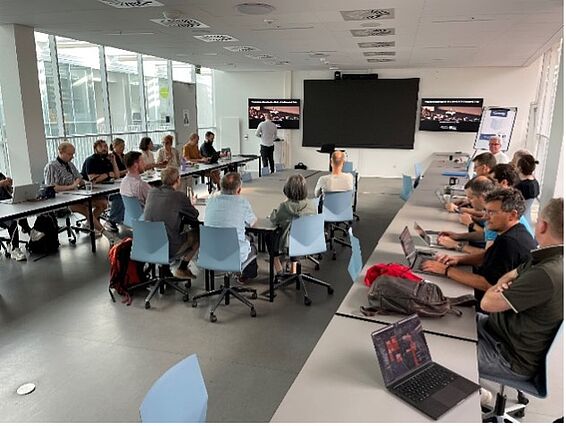
In August 2026, Professor Paul Denny from the University of Auckland visited Denmark at the invitation of It-vest. During his visit, he met with computer science and software engineering departments across Western Denmark to discuss the impact of generative AI on computing education and explore how the field is evolving in response to new technological developments. Furthermore he participated in the It-vest Symposium: Generative AI and the Future of Computing Education.
During your stay, you participated in the symposium “Generative AI and the Future of Computing Education” and visited several computer science and engineering departments at universities in western Denmark. What have been your primary observations?
I am very grateful to It-vest for making this visit possible, and for all of the amazing help and assistance in running the It-vest symposium! I’m also indebted to Honorary Professor Michael E. Caspersen for proposing the idea for the visit, and for the symposium, back in November last year. It has been a lot of fun to plan and exciting to see it come to life. I have thoroughly enjoyed all aspects of the visit, and my time in Denmark has been very enjoyable and productive.
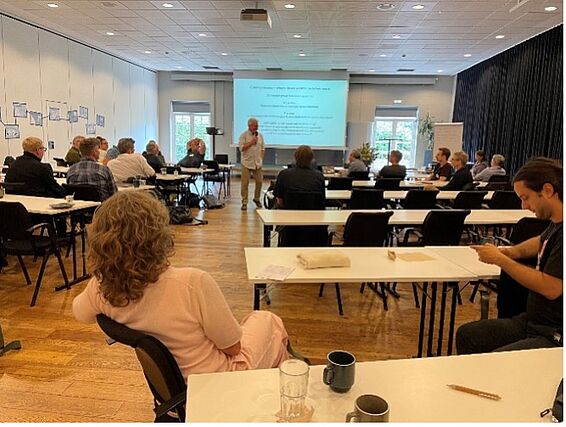
Perhaps the clearest single observation from all of the visits and the symposium is that generative AI is an urgent issue at the centre of everyone’s thinking. The timing of the visit has coincided with the beginning of the teaching semester in Denmark, and it has been clear from all of the conversations I have had that generative AI is forcing educators to reconsider what they teach, how they teach it, and how they assess whether students have genuinely learned.
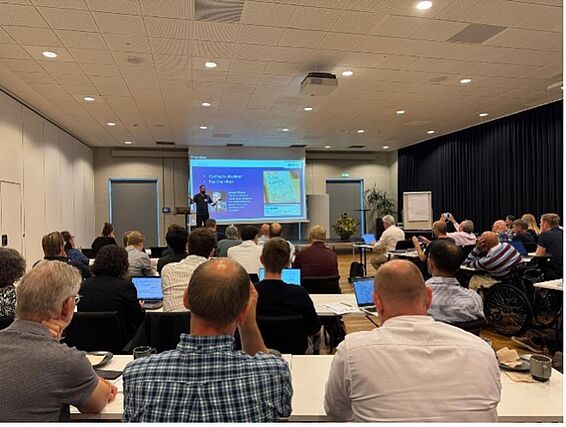
I was also struck by just how much interesting work is already happening. At the symposium and during my visits to the different campuses, I heard about many thoughtful attempts to integrate AI into teaching while still protecting student learning. Of the many great ideas, these included course-specific digital tutors built around teaching materials (e.g. Henrik Bærbak on "Course Specific Chat bots as a student aid in learning"), oral examinations that probe students’ understanding of the work they have produced (e.g. such as is standard as part of the PBL-model pioneered at Aalborg), and new kinds of introductory programming activities that balance the need to build foundational skills and expose students to new aspects of AI (e.g. Jens Bennedsen on "Including Generative AI in learning introductory programming").
At the same time, there is not yet a clear consensus about best practice or how the curriculum as a whole should change. Much of the innovation is currently happening at the level of individual courses, often led by particularly motivated instructors. That is understandable given how quickly the technology is moving, but the next challenge will be connecting these individual efforts and thinking more systematically across entire programmes.
I found the second day of the symposium, which had an industry-focus, particularly eye-opening. We heard how radically AI has already changed software engineering practice in some organisations. Developers are increasingly offloading both code generation and test generation to models, while spending more time directing and coordinating agents. AI agents are also becoming involved in activities such as reviewing pull requests, and those same agents are generating changes much faster, and at a much greater scale, than human developers. This message was reinforced during a visit to Aalborg University, where I attended and spoke at the Computer Science Seminar Day, by a senior software engineer at Maersk. They described a very enthusiastic approach to utilising AI agents that has changed radically even in the last few months. Engineers were writing very little code, and focusing their efforts on reviewing changes and orchestrating agents – as well as how to manage token usage!
There is clearly still a gap between what is happening at the most AI-forward companies and what is typical across the whole industry. Even so, the trends seem clear, and it reinforces how important it is for universities to respond.
Has your stay contributed to your research, and if so, in what ways?
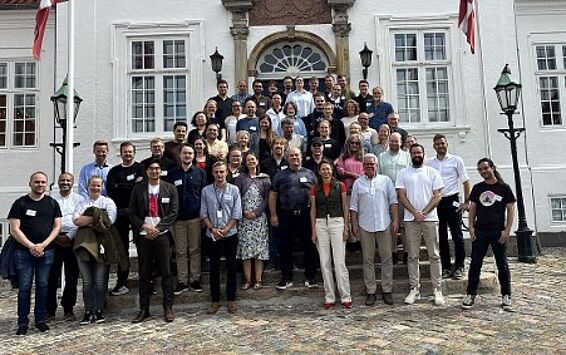
Yes, very much so! One of the most valuable aspects of the visit has been the opportunity to spend dedicated time with people who are thinking deeply about the same questions. The symposium brought together researchers, educators and industry practitioners with quite different perspectives, which led to many useful conversations and opened possibilities for future collaboration. I have a much expanded contact list now! I also have enjoyed listening to (and sometimes providing advice on) everything from research projects to grant applications, and I look forward to continuing these conversations when I am back in Auckland.
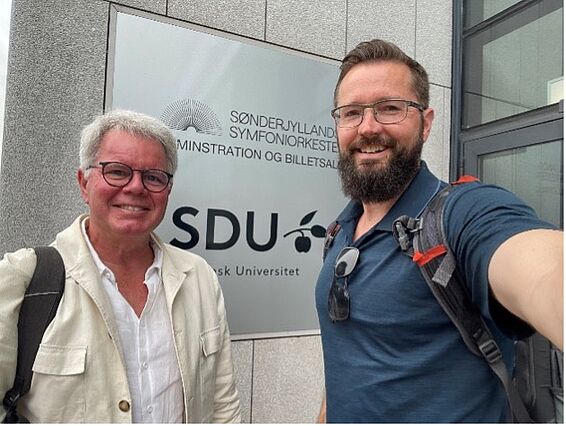
The individual university visits were particularly valuable because we could focus on the specific challenges that departments and instructors are seeing. At SDU, for example, we discussed the possibility of designing collaborative activities in which students practise writing natural language specifications for computational tasks. Being able to describe precisely what a system should do is becoming increasingly important when working with AI. Making this a collaborative classroom activity could also help students form social connections, which is something we need to pay attention to as more learning and problem-solving takes place through individual interactions with AI tools.
Several of these discussions generated direct ideas for new empirical studies, as well as opportunities to test approaches across different institutions and educational contexts. They have also helped me sharpen my thinking about the relationship between foundational knowledge and the new skills students need when they work with AI.
It has also helped me reflect on my teaching directly, and on our role as educators. At the introductory level, students still need core computer science knowledge and a clear understanding of how programs work. In my view, the best way to achieve this is with carefully designed tasks and scaffolded environments that focus students on the intended learning (e.g. the classic “Parsons problems” are a good example of how computing educators have done this in the past, well before AI). By their final year, however, students should be working on substantial projects and learning to use contemporary, industry-standard AI tools responsibly.
The visit also allowed me to spend face-to-face time with existing colleagues. Personally, I find that makes an enormous difference. Ideas that would otherwise take weeks to develop through occasional online meetings can move forward very quickly when people can sit together and sketch things out. The old adage of “you can’t replace face to face” is absolutely true!
How do you view the future for software developers?
Personally, I am quite positive about the future for software developers, although I think their everyday work and tasks will be (and already are) changing considerably.
Some of the tasks traditionally associated with programming, such as writing source code, are now increasingly performed by AI. Developers will spend more time specifying what needs to be built, breaking larger problems into manageable pieces, coordinating AI agents, checking the quality of their outputs, and taking responsibility for whether the resulting systems are correct, secure and appropriate. This creates a difficult problem for educators. It is hard to design a course around any particular AI technology because the tools and workflows may have changed before we finish teaching it (a point that Michael Lind Mortensen, in his excellent industry talk "From SDLC to AIDLC: An AI First Industrial Revolution", also emphasised).
There have certainly been some negative headlines about reduced hiring of junior developers, particularly in the United States. I suspect at least some of this is an immediate knee-jerk reaction to the rapid emergence of AI tools, rather than a long-term indication of the future. As software becomes cheaper and faster to produce, we are likely to build more of it, including larger and more ambitious systems. At the same time, people in fields outside software engineering will increasingly use programming and AI to create prototypes, automate aspects of their work and solve problems for which they previously would not have used software. At the University of Auckland, for example, several science courses are now engaging students in basic programming tasks (where the focus is mainly on verifying the output, rather than carefully examining and fully understanding the source code, as would be expected of computer science students).
What particular strengths do the universities in western Denmark bring to this area?
Many! I think some of their greatest strengths are the well-established approaches around active, collaborative and problem-based learning. This is especially visible in Aalborg University’s model of problem- and project-based learning, but the wider emphasis on students working actively with authentic problems was evident throughout my visit.
The Aalborg model of problem-based learning encourages students to work on academically and socially relevant problems, make and justify their own decisions, learn with others, reflect on how they work, and apply what they learn beyond a single task. These principles all seem particularly well suited to education in the age of generative AI. Assignments that simply ask students to produce a familiar piece of code are easy to outsource to AI and not very engaging for most students. Instead, having students identify a worthwhile problem, understand its context, decide what should be built, compare possible approaches, and evaluate the result are much more engaging and authentic.
I especially think the collaborative dimension is important. AI tools are often used individually, which risks making learning an isolated experience (we heard anecdotes at the symposium about tools like ChatGPT ‘eroding’ social connections between students). Group projects require students to articulate ideas, negotiate different perspectives, and learn from one another. These are valuable educational outcomes and they mirror the human skills that will remain essential in AI-supported software development.
In addition, the close connections to industry and a clear willingness to experiment and try new things, puts the universities in western Denmark in a very good position!
Can you identify two or three areas where it would be relevant for the universities in western Denmark to collaborate within computing education?
One thing that struck me during the campus visits was that there is scope for more collaboration. This includes between relevant departments at the same university, between campuses, and across the three institutions. People are already doing innovative work, but they are not necessarily aware of everything happening elsewhere.
The first opportunity is therefore a more systematic approach to sharing examples of how educators are adapting courses and assessments. I was a member of the ACM Education Advisory Committee’s Task Force on Generative AI and Assessment, which surveyed hundreds of instructors around the world. One of the barriers educators repeatedly identified was a lack of concrete examples. They know change is needed, but they do not always know how to go about it. The universities in western Denmark are already developing many useful approaches, so there would be real value in documenting, evaluating and sharing them more widely.
That leads to a second opportunity around collaborating on computing-education research. Many of the teaching innovations I saw could form the basis of strong empirical studies, particularly if they were evaluated across several institutions. This would produce more generalisable findings and create opportunities to publish the work internationally through venues such as those supported by ACM SIGCSE. This is something I am very passionate about helping to support, and something I made quite clear in my campus visits!
A third area is collaboration with industry. Denmark has a thriving technology sector, and the symposium showed the value of bringing industry voices directly into the conversation. Universities could work together to track how professional practice is changing and identify the capabilities employers want from graduates.
Finally, we’ve discovered that you’ve developed a fondness for cinnamon rolls—have you found a favourite?
While it is true that I have always had a fondness for “Danish pastries,” eating them in Denmark is a unique experience!
I have become particularly fond of cinnamon rolls in both of their common forms. This includes the flaky kanelsnegle from Lagkagehuset and the softer, more dough-like version from La Cabra. Asking me to choose between them would be unfair to both!
I have, however, learned that cinnamon-roll consumption needs to be balanced with exercise. Fortunately, I was invited to join one of Aarhus University’s teams for the DHL relay, in which each participant runs five kilometres (I managed to finish in 24:07; worth at least two cinnamon buns!). It was great fun and a wonderful way to feel included in university life here.
Once again, I am very grateful to It-vest for making this happen and supporting these important conversations. I look forward to visiting Denmark again!