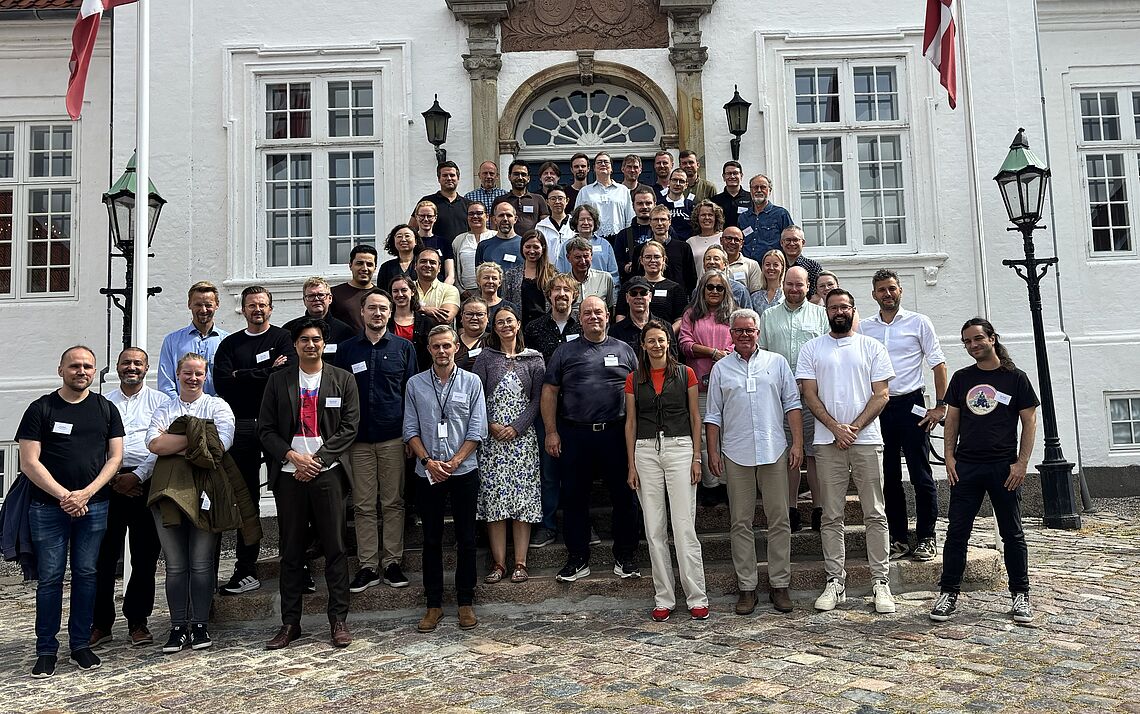
It-vest Symposium: Generative AI and the Future of Computing Education
This conference has been held
How do we teach computer science and software engineering in an era defined by Generative AI?
It-vest invites you to a deep dive into the fundamental shifts currently reshaping our field. The symposium is not just about discussing the future—it is about navigating it.
Participation is free of charge.
The programme will feature invited presentations by international experts, colleagues from the universities in Western Denmark, and industry representatives.
By the end of the event, you will:
- understand current research and classroom practices
- leave with actionable teaching and assessment ideas
- hear student and industry perspectives
- share institutional policies and practices
- identify collaborative research opportunities
Program
Monday 17th August
09.15: Arrival
10.00: Session 1: Opening and welcome
Birgitte Egeskov Jensen, Head of It-vest
Michael E. Caspersen, Honorary Professor, PhD, AU
Paul Denny: Programming Education in a World of AI-Generated Code
11.00 Break
11.30: Session 2: Lightning talks I
Initiatives and experiences from SDU, AAU and AU (Session chair: Michael E. Caspersen)
Emanuela Del Dottore, SDU
AI-Aided Pair Programming to Enhance Engagement and Algorithmic Thinking in Computing Education
Chunfang Zhou, SDU
‘Ah!- HaHa! - Aha!’: An Emotion-Mediated Model for Human-AI Co-Creative Learning
Adam Alami & Aslak Johansen, SDU
AI in Programming Courses: What Students Actually Think and Do
Andreas Møgelmose, AAU
Introducing students to AI with AI
Daniela Koch, AAU
Fostering Critical Thinking: Mitigating GenAI Overreliance in Programming Education
Kasper Rodil et al., AAU
BuddhAi: Entangling Local Compute, Problem-Based Learning, and Multi-Modal Dialogue in Education for Novice Programmers
Henrik Bærbak, AU
Course Specific Chat bots as a student aid in learning
Jens Bennedsen, AU
Including Generative AI in learning introductory programming
12.30: Lunch
13.20: Session 3: Invited presentations I
Session chair: Paul Denny
Leo Porter: Helping Faculty Integrate AI into CS Education
The advent of GenAI necessitates changes to the CS curriculum and our courses. These changes include updating our assessment practices, tools for supporting students, and the skills we teach. Given the scale of these changes and the rapid pace of AI advancements, this talk will outline the challenges faculty face when incorporating GenAI into their CS classes. For each challenge, I'll share lessons learned from our introductory programming course at UC San Diego. Lastly, we'll discuss how the GenAI in CS Education Consortium seeks to help faculty navigate this evolving landscape.
Natalie Kiesler: Students' Engagement with GenAI Tools and their Feedback
As generative AI tools become increasingly ubiquitous in higher education, understanding how students engage with AI-generated feedback is crucial for utilizing them in education or as part of customized educational tools. This talk presents emerging research on how students perceive, engage, and act upon feedback provided by generative AI systems, and the extent to which it meets their informational and learning needs. It also discusses preliminary findings from an ongoing ITiCSE Working Group on accessibility and generative AI tools, highlighting recent research and tool features. Together, these perspectives contribute to a deeper understanding of how GenAI tools can be designed and used to support more accessibility and student support in computing education.
Juho Leinonen: Generating Learning Resources with AI
Generative AI can support the creation of teaching materials for computing education, including programming exercises, interactive online textbook content, and lecture slides. Drawing on examples from course development, I will highlight where AI is genuinely helpful, where human expertise remains essential, and how educators can use AI as a drafting and ideation partner without compromising pedagogical quality.
David Smith: Code-generation Based Grading: EiPL and Prompt Problems
The advent of GenAI is shifting the skills we teach novice programmers, with growing emphasis on prompting and code comprehension over writing code from scratch. In this talk, David will describe code-generation-based grading, a mechanism for scalable, formative practice in these skills. It powers two activities: Explain in Plain Language (EiPL), where students describe in natural language what a piece of code does, and Prompt Problems, where students write the prompt that gets a model to produce code matching a set of examples. In both, the student's response is turned into code and run against unit tests, providing immediate feedback. The talk concludes by situating these activities within a broader effort to enable effective formative practice in natural-language programming, particularly forms in which students are empowered to bring their full meaning-making repertoire—all varieties of natural language (not only English), diagramming, and drawing—to bear on programming task.
15:00 Break
15.30: Session 4: Lightning talks II
Initiatives and experiences from SDU, AAU and AU (Session chair: Michael E. Caspersen)
Edward Abel & Zhiru Sun, SDU
There and Back Again: Integrating Vibe Coding and Programming Foundations in a Three-Phase Course Structure
Robb Mitchell & Edward Abel, SDU
Collective Prompting Playgrounds: Designing Low-Stakes Multi-User Interfaces for Collaborative Prompting
Anders Rysholt Bruun, AAU
Changing roles of UX designers in the age of GAI
Morten Konggaard Schou, AAU
The struggle of learning when AI invades the programming classroom
Rune Møberg Jacobsen, AAU
Making Generative AI Visible, Social, and Teachable: Lessons from the Prompt Machine
Søren Bolvig og Peter Vistisen, AAU
When Designers Know More Than They Can Prompt: Embodied Design Thinking Meets Vibe Coding
Søren Bolvig et al., AAU
Sketching, Prototyping and Vibe-Coding as Entry Points in Product Development
Clemens Nylandsted Klokmose, AU
CoTinker, AI, and future digital learning environments
16:30 Break
17.00: Session 5: Round table discussions
Session chair: Michael E. Caspersen & Paul Denny
18.00: Session 6: Wrap-up over a glass of crémant
Presentation of “posters” – one-minute madness
20.00: Dinner
Times, sessions and speakers are subject to change
Tuesday 18th august
09.00: Session 7: Industry voices
Session chair: Bettina Lundgaard, It-vest
Helena Marie Meyer: Still Figuring It Out: A Developer's Honest Take on AI
After more than 20 years of writing code, Helena has spent the last 4 months exploring a new kind of colleague: AI. In this talk, she shares what she's learned from bringing AI tools into her daily workflow — as someone who has always been drawn to new technology and loves learning and embracing change. She'll share stories — from feeling lonely working with AI instead of people, as well as the moments where AI made her work faster, sharper, and more fun. But throughout her career, she has also learned the most by making her own mistakes, and that raises a real concern: Can she still learn that way in the AI era?
Michael Lind Mortensen: From SDLC to AIDLC: An AI First Industrial Revolution
The classical software lifecycle is becoming AI First: agents write, compile and review the code. The development process is being reimagined around AI. This is happening already on a large-scale – at Bankdata, Uber, LEGO, Microsoft and many other companies developing software at scale.
What skills will computer scientist and software engineers need when AI primarily writes the code? The talk closes by suggesting core competencies of the future.
Aino Corry: What is the Future of Software Development?
Based on a recent retreat of that name, Aino is bringing knowledge, ideas, fears, and hopes from software developers around the globe. One thing that we could agree on is that we need a language to talk about the use of GAI. When OO hit our field we found the use of Christopher Alexander's pattern languages to share experience in OO design useful, and they are still used in teaching and development. It seems the time is ripe for us to build a pattern language that can be used for GAI in software development, in teaching, in research, and in management in the software field.
10:30 Break
11.00: Session 8: Invited presentations II
Session chair: Paul Denny
Arto Hellas: Teaching Software Engineering with Large Language Models – What We Should Have Learned Yesterday
Large language models are changing software engineering practices at a rapid pace. Drawing on experience teaching a course on Software Engineering with Large Language Models since 2023 -- with the initial versions tailored for industry professionals -- this talk will revisit the expectations from early 2023 and how the course has evolved since then. Which predictions proved accurate, what aged poorly, and what new developments did we fail to anticipate? The talk will also discuss the shift from prompting and code generation toward broader workflows and increasingly agentic tools, and consider what software engineers should have learned yesterday -- and may no longer need tomorrow.
Hieke Keuning: How inevitable is Generative AI in computing education?
Almost every paper in the field starts with the claim that GenAI 'reshapes' or 'transforms' education, software engineering, or software engineering education. At the same time, AI resistance is increasing, and negative aspects of GenAI are receiving more and more attention. In this talk I will adopt a more critical view on integrating GenAI, and discuss aspects that are often ignored or overruled in computing education contexts.
Andrew Luxton-Reilly: Assessment Policies and Issues: An Associate Dean Perspective
Generative AI has fundamentally altered the education landscape, impacting most immediately on assessment. Our practices and policies must necessarily adapt. This talk explores the issues from an institutional perspective.
James Prather: A Vision of the Future of Computing Education
Generative AI (GenAI) has drastically changed the software engineering industry in just three years. We know our curriculum must change to incorporate GenAI, but the details are unclear. What should we start teaching? What should we stop teaching? Some initial approaches have continued the previous paradigm with GenAI on top. These do not go far enough as the field itself has moved into an entirely new paradigm. In this talk, I will present a new vision for Computing Education that focuses on three big ideas: a new introductory course, a new model for learning programming fundamentals, and a new approach to software engineering courses.
12.40: Lunch
13.30: Session 9: The future of computing education (panel)
Discussion of challenges, opportunities, and joint initiatives (Session chair: Brent Reeves)
Aino Corry, Founder of Metadeveloper
Marianne Graves Petersen, Professor and deputy head of education, Department of Computer Science, Aarhus University
Andreas Møgelmose, Associate professor, CREATE, Department of Architecture, Design and Media Technology, Aalborg University
Adam Alami, Associate professor, The Mærsk McKinney Møller Institute, University of Southern Denmark
Andrew Luxton-Reilly, Professor, Department of Computer Science, University of Auckland
14:30 Break
15.00: Session 10: Ideas for R&D activities and projects
Session chair: Michael E. Caspersen & Paul Denny
16.00: The end
Times, sessions and speakers are subject to change
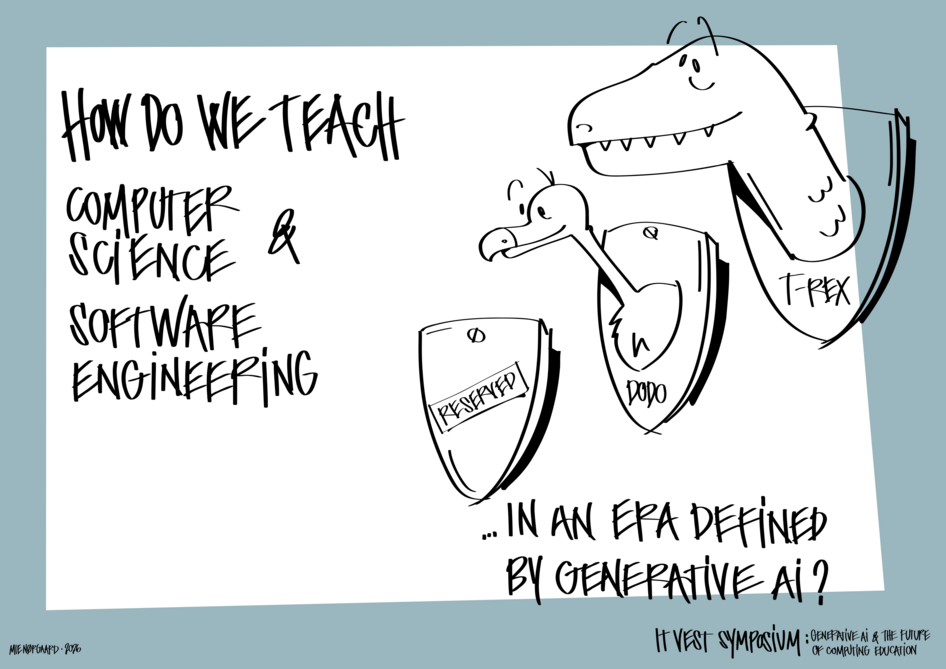
Illustrations from the conference
Click on the image below to see a selection of Mie Nørgaard's illustrations, which present a number of key points from the conference.
Speakers
Paul Denny, Professor, University of Auckland
Leo Porter, Professor, University of California San Diego
Natalie Kiesler, Professor Dr., Nüremberg Tech
Juho Leinonen, Assistant Professor (tenure-track), Aalto University
David H. Smith IV, Assistant Professor, Virginia Tech
Arto Hellas, Senior University Lecturer, Aalto University
Hieke Keuning, Assistant Professor, Utrecht University
Andrew Luxton-Reilly, Professor, University of Auckland
James Prather, Associate Professor, Abilene Christian University
Brent Reeves, Professor, Abilene Christian University
Helena Marie Meyer, Senior software developer, Trackunit
Date & Venue
The Symposium was held on the 17-18 August at Comwell Bygholm Park, Horsens.